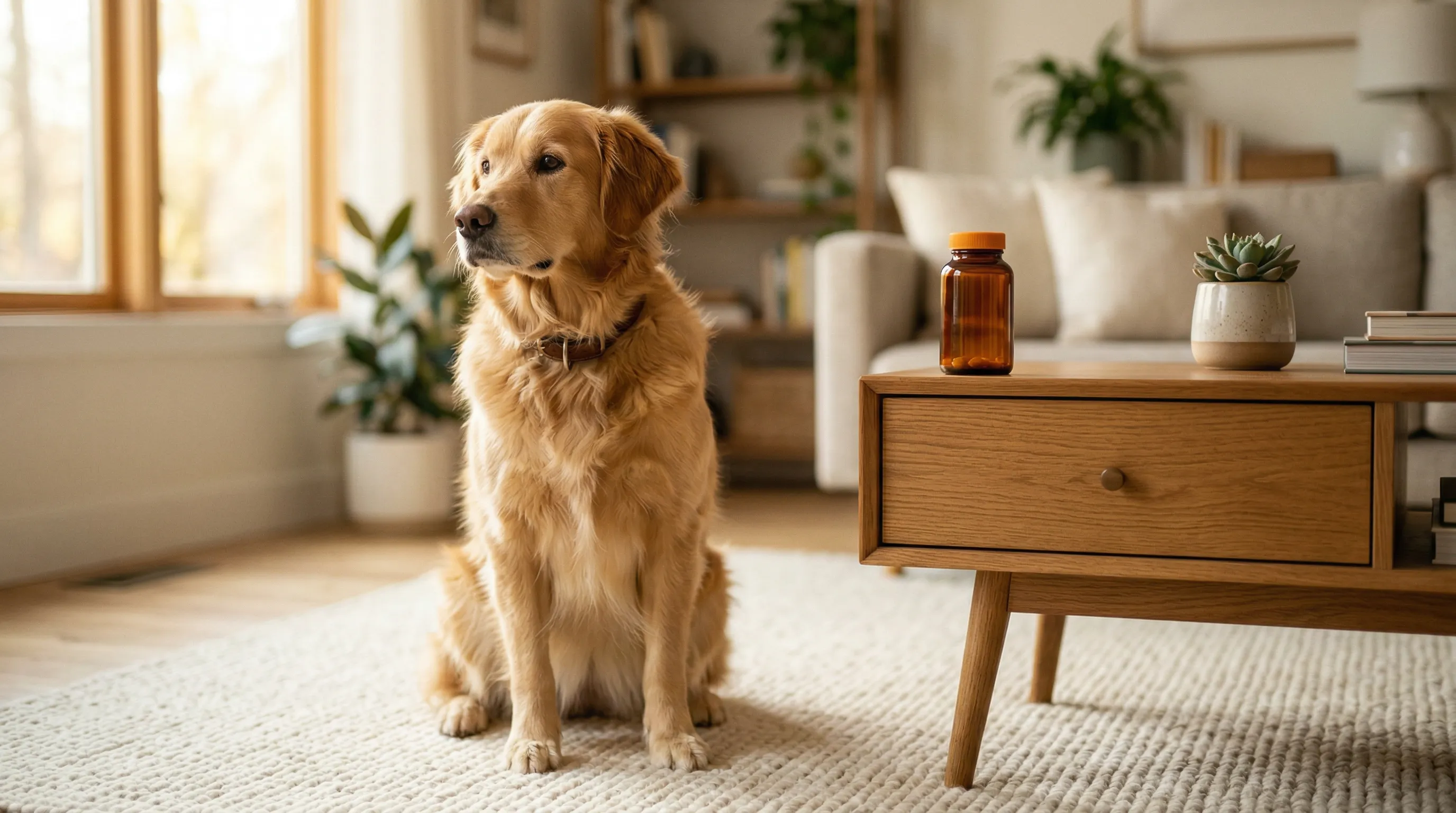
Is There an Ozempic for Dogs?
Short answer: not yet — but the first GLP-1 trials in companion animals are running in cats right now. Here's the real status.
There is no FDA-approved Ozempic, Wegovy, or any other GLP-1 receptor agonist for dogs as of April 2026. Veterinarians cannot legally prescribe human GLP-1 medications to dogs — the dosing, safety, and metabolism are completely different between species. The closest things in development are two separate cat trials: Okava Pharmaceuticals' OKV-119 implant (the MEOW-1 trial, an exenatide-releasing implant) and Akston Biosciences' AKS-562c, a once-weekly GLP-1 Fc-fusion injection running at Cornell University. Dogs are the next planned species for both companies — but there is no announced clinical timeline yet.
If your dog is overweight, the question every vet will tell you is the same: it's almost always a calorie problem, not a metabolism problem. A weight loss food, portion control, and structured exercise solve the majority of canine obesity cases. The minority of dogs who need medical intervention have other underlying conditions (Cushing's, hypothyroidism, pain limiting movement) that need their own treatment, not GLP-1.
Why You Can't Get Ozempic for Your Dog (Yet)
Semaglutide (the active ingredient in Ozempic and Wegovy) is FDA-approved for humans only. Three reasons it isn't prescribed off-label for dogs:
- Species-specific dosing has never been studied for dogs. Human dosing scales by body weight, but GLP-1 receptor density and incretin response differ significantly between species. A 'safe' human dose could be sub-therapeutic or unsafe in a dog of any size.
- Pancreatitis risk requires careful evaluation in dogs. Dogs are predisposed to pancreatitis, particularly certain breeds (Miniature Schnauzers, Yorkshire Terriers, Cocker Spaniels). GLP-1 medications carry pancreatitis warnings even in human labels. Combining the two without canine-specific safety data isn't something any vet will sign off on.
- Veterinary GLP-1 development is several years behind human GLP-1 development. The first canine GLP-1 won't be a copy of Ozempic — it'll be a purpose-built molecule like Okava's OKV-119 implant or Akston's AKS-562c injection.
What's Actually in Trials Right Now
Okava OKV-119 — The MEOW-1 Trial (Cats)
Okava Pharmaceuticals is developing OKV-119, a small subcutaneous implant designed to slowly release exenatide (a GLP-1 receptor agonist) over approximately 6 months. The current trial, called MEOW-1 (Management of Excess Overweight cats With OKV-119), enrolls at least 50 cats — about two-thirds receive the implant, the rest serve as controls. Owners track their cats over a 3-month observation period with an optional 3-month extension. Per Okava's announcement, results are expected summer 2026. Dogs are the next planned species but no canine trial has been formally announced.
Akston AKS-562c — Cornell University (Cats)
Separate from Okava, Akston Biosciences is running a feline trial at the Cornell University College of Veterinary Medicine. Their candidate, AKS-562c, is a once-weekly GLP-1 Fc-fusion injection — a different molecule and a different delivery format from Okava's implant. The Cornell trial is enrolling 70 cats with the option to expand to 140, over a roughly 3-month period. Akston announced trial initiation in November 2025.
Realistic dog availability: Even in the best case, neither company would have an FDA-approved canine product before 2028 or 2029. Veterinary drug development from Phase 2 cat trials to FDA approval for dogs typically takes 3-5 years.
What You Can Actually Do Right Now (If Your Dog Is Overweight)
The good news: canine weight loss without medication has a much higher success rate than human weight loss without medication. Dogs don't have the willpower problem — they have the portion problem. Fix the portions, fix the dog.
- Confirm your dog is actually overweight. Use the Body Condition Score (BCS) — a 9-point scale that vets use to assess body composition. Most owners can't tell their dog is overweight by looking. Free Dog Weight Checker tool.
- Switch to a weight management food. Vet-formulated weight loss dog foods reduce calorie density while maintaining protein and nutrients — so your dog still feels full. See our weight loss dog food guide for the top vet-recommended options.
- Calculate the right portion. Many overweight dogs are eating more calories than they need. The food bag's instructions are based on active adult dogs at ideal weight. Your vet or a feeding calculator can dial this in based on your dog's ideal weight, not current weight.
- Add structured exercise gradually. Don't take an obese dog on a 5-mile hike on day one. Start with shorter walks twice a day and build up over several weeks. Joint pain is common in obese dogs — be patient.
- Re-weigh regularly. Vets generally recommend safe weight loss in dogs at roughly 1-2% of body weight per week. Slower is fine. Faster than that can cause muscle loss and other complications.
Get Notified When Pet GLP-1 Launches
We track Okava's OKV-119 (MEOW-1 trial) and Akston's AKS-562c (Cornell trial) progress, plus any other veterinary GLP-1 developments. When the first canine GLP-1 hits the market, we'll send one email letting you know how to access it. No spam, no other emails.
What About Compounded Semaglutide for Dogs?
Don't. Some compounding pharmacies and gray-market vendors will sell semaglutide vials marketed for 'research use.' Giving these to your dog is uniquely risky because: (1) dosing is guesswork — there is no published canine semaglutide protocol, (2) compounded peptides have documented contamination and purity problems even when produced for human use, and (3) if your dog has an adverse reaction, you have no veterinary protocol for emergency care. Wait for OKV-119 or AKS-562c, or work with your vet on conventional weight loss. The risk/reward math is not close.
Frequently Asked Questions
Can I give my dog Ozempic at a smaller dose?+
Is there any FDA-approved weight loss drug for dogs right now?+
When will Okava OKV-119 be available for dogs?+
Is the Akston Cornell trial the same as Okava's trial?+
What's the best weight loss food for dogs while waiting for GLP-1?+
Related
Veterinary disclaimer:This article is for informational purposes only and does not constitute veterinary advice. Always consult a licensed veterinarian before changing your dog's diet, exercise routine, or medication. Information is current as of the publication date but pet pharmaceutical and food formulation details may change.
Looking for human GLP-1 medications instead?
See our 40 verified GLP-1 telehealth providers →