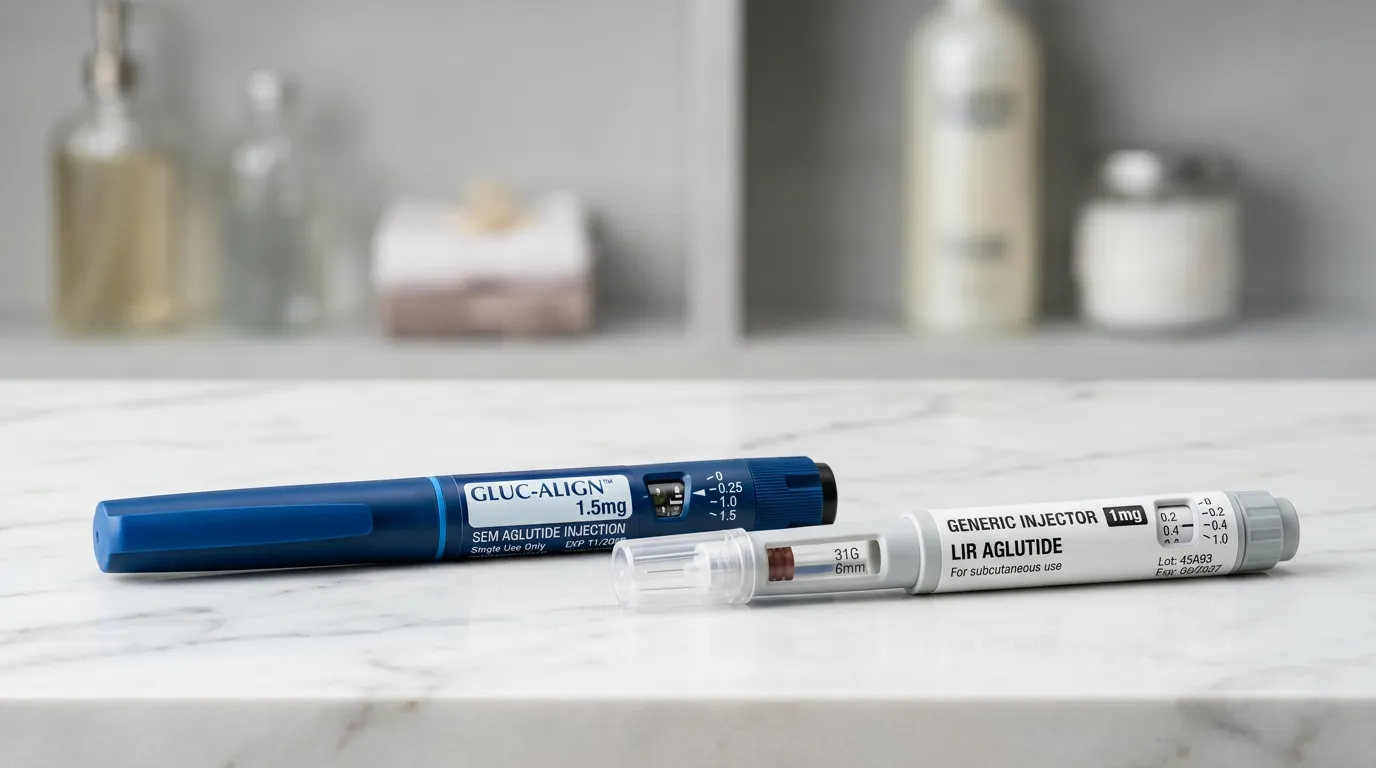
Brand vs Compounded GLP-1 (2026): Wegovy From $199 vs Compounded Options
Verified August 7, 2026: NovoCare lists the brand-name Wegovy pen at $199/mo for the first two low-dose fills, then $349/mo at standard strengths ($399 for HD) and the oral pill from $149/mo, dose-dependent; Zepbound starts at $299/mo via LillyDirect. Compounded offerings may advertise lower prices but require product- and prescription-specific regulatory review.
Summarize this article with
Verified August 7, 2026: NovoCare lists the brand-name Wegovy pen at $199/month for the first two low-dose fills, then $349/month at standard strengths ($399 for HD) and the oral pill from $149/month, dose-dependent; LillyDirect lists Zepbound at $299-$449/month by dose and refill conditions. Telehealth services advertise compounded tirzepatide from $99 for the first month ($280/month after) and compounded semaglutide from $49 for the first month ($212/month after) through Enhance MD, but those are unapproved products, not brand equivalents. Semaglutide and tirzepatide shortage-based transition periods ended in 2025. Any current compounded preparation requires a case-specific 503A or 503B and state-law analysis; availability is not proof of compliance.
Quick answer by situation:
- •Considering a lower-priced compounded program: Enhance MD advertises semaglutide from $49 for the first month and tirzepatide from $99 for the first month. Confirm the ongoing price, exact product, dispensing pharmacy and applicable legal pathway; the listing is not a compliance certification.
- •Want an FDA-approved brand cash path: NovoCare lists the Wegovy pen at $199/month for the first two low-dose fills, then $349/month at standard strengths ($399 for HD) and the pill from $149/month, dose-dependent; LillyDirect lists Zepbound from $299/month for the starter 2.5mg vial.
- •Medicare beneficiary: Coverage went live July 2026 at $50/month copay, see the Medicare Part D GLP-1 guide.
- •Still on compounded semaglutide: It's been enforced against since April 2025. See the compounded crackdown guide for switch options.
This guide breaks down the four-part decision, legality, safety, cost, and weight loss outcomes, using FDA enforcement timelines, current provider pricing, and clinical trial data. Patients who want to avoid injections entirely have two FDA-approved oral options starting at $149/mo, see the oral GLP-1 pills guide. Verify any provider with our FDA Safety Checker or compare all 54 telehealth programs by cost and score.
Comparing your options?
See every verified GLP-1 program ranked side by side on cost, safety, and care quality. The cheapest we track right now is $69/mo.
Compare all 54 GLP-1 providers →Is compounded semaglutide the same as Wegovy?
No. It is the same active molecule in a different product that the FDA has never reviewed. That distinction is not a technicality, and it is the thing most comparisons skip straight past on their way to the price.
Wegovy is Novo Nordisk's FDA-approved semaglutide, manufactured under inspected conditions and sold in pre-set pen doses. Compounded semaglutide is mixed by a compounding pharmacy, is not FDA-approved, and is not assessed for safety, effectiveness or quality before it is sold. There is no bioequivalence finding between them, because bioequivalence is a specific FDA determination and compounded drugs never receive one. Anyone telling you a compounded product is "bioequivalent" or "identical" to Wegovy is describing something the FDA has not concluded, and the FDA has issued warning letters over exactly that claim.
There is also a question almost nobody asks, and it is the one worth asking. Some compounded products have used semaglutide salt forms, semaglutide sodium or semaglutide acetate, rather than the semaglutide base that is in Wegovy. The FDA has stated these salt forms are different active ingredients from the approved drug. A legitimate pharmacy will tell you in writing which form it dispenses. A program that will not answer that question has told you something.
- •Ingredient identity: ask the dispensing pharmacy what substance and concentration it used. FDA has not established a compounded product as identical or equivalent to Wegovy, and semaglutide sodium or acetate salt forms differ from the base form in the approved brand.
- •Manufacturing standard: Novo Nordisk's inspected facilities, versus a 503A state-licensed pharmacy or a 503B outsourcing facility.
- •FDA approval: Wegovy is approved and reviewed. The compounded product is neither, and no compounded drug is.
- •Dose form: pre-set pen doses versus a vial you draw yourself, which is where the FDA's documented 5x to 20x overdoses have come from.
- •Cost: NovoCare Pharmacy lists the Wegovy pen at $199/month for the first two low-dose fills, then $349/month at standard strengths ($399 for HD) and the oral pill from $149/month, dose-dependent (verified August 7, 2026). Compare the exact dose, form, eligibility and ongoing checkout total rather than treating either floor as universal.
The short version: a compounded product is not Wegovy, not an approved generic, and not established by FDA as identical or clinically equivalent. The price gap can be real but is often smaller than marketing implies once you compare ongoing rates rather than introductory ones. See our quick answer on compounded versus Wegovy if you want it in one paragraph.
Join the list for the GLP-1 Letter.
We re-verify every price on this site against the provider's own live page and check every program against the FDA warning letter database. Join the list and you will hear from us when that work turns up something worth an email. No promised schedule until we are actually keeping one. Unsubscribe anytime.
No affiliate spam. No retargeting pixels. Unsubscribe in one click.
What Are Compounded GLP-1s?
Compounded GLP-1 medications are custom-mixed formulations prepared by compounding pharmacies using the base active ingredient (semaglutide or tirzepatide). They are NOT FDA-approved products and they are NOT generics. There are two types of compounding pharmacies:
- •503A pharmacies: Traditional state-licensed compounding pharmacies that fill patient-specific prescriptions
- •503B outsourcing facilities: Larger-scale facilities registered with the FDA that can produce compounded drugs without patient-specific prescriptions
Are Compounded GLP-1s Still Legal in 2026?
Shortage status is one pathway that can affect whether a compounder may make a drug that is essentially a copy, but sections 503A and 503B contain separate conditions and exceptions that require a case-specific analysis. The key dates are:
- •February 21, 2025: FDA removes semaglutide from the drug shortage list
- •April 22, 2025: FDA's temporary shortage-based enforcement-discretion period ended for 503A pharmacies
- •May 22, 2025: FDA's temporary shortage-based enforcement-discretion period ended for 503B outsourcing facilities
- •September 2025: FDA warning letters cited false or misleading marketing by individual compounders; our FDA alerts tracker lists the sourced records we have reviewed and is not an exhaustive FDA total
- •February 2026: FDA announces seizure and injunction powers against non-compliant compounders
- •April 30, 2026: FDA proposes permanent exclusion of semaglutide, tirzepatide, and liraglutide from the 503B bulk drug substances list (Federal Register publication May 1, 2026). FDA found no demonstrated clinical need for outsourcing facilities to compound these drugs from bulk substances. Comment period extended to July 30, 2026 (from June 29 via FR 2026-12937, published June 26, 2026) before any final rule.
FDA resolved the tirzepatide shortage on October 2, 2024 and ended temporary shortage-based enforcement discretion in early 2025. A patient-specific 503A prescription is not categorically prohibited by that shortage decision, but it still must satisfy all applicable statutory and state-law conditions, including the essentially-a-copy analysis.
Editor's Top Pick
Embody
from $69/mo · 7.3/10 · Compounded
Online weight-loss program that ships compounded GLP-1 medication to your door. Modern Metabolic Medicine, Inc. runs the storefront and OpenLoop Health supplies the clinical network on the current site. Embody now advertises compounded semaglutide from $79 and GLP-1 + GIP from $129; its FAQ says the chosen rate holds within a selected 4-, 12-, 24- or 52-week plan. Its standout is oral tirzepatide gum for people who do not want injections.
Are Compounded GLP-1s Safe?
The FDA has documented significant safety issues with compounded GLP-1 products:
- •Dosing errors tied to varying concentrations, vial sizes, and patients measuring doses in syringe units rather than milligrams
- •Reports of patients administering substantially more than the intended dose, including cases requiring medical care or hospitalization
- •Use of semaglutide salt forms that differ from the base form in FDA-approved products
- •Fraudulent or mislabeled products represented as coming from licensed compounders
- •Adverse-event reports involving compounded semaglutide and tirzepatide; reporting alone does not establish causation, and FDA notes reporting requirements differ
Provider-level records matter too. FDA warning letter #721455, issued February 20, 2026, says MEDVi labels implied that MEDVi compounded products it did not compound and that its comparisons implied equivalence with approved brands. The letter is about misbranding and marketing, not an allegation that the medication was unsafe. Read our MEDVi review for the price and service record, or the focused MEDVi legitimacy analysis for the official letter and our verification status.
Not sure which GLP-1 program is right for you?
Take the 60-second quiz, we'll match you against 54 verified providers on your goals, budget, and medication preference, then surface your top 3.
Take the 60-sec QuizBrand vs Compounded: Direct Comparison
| Factor | Brand-Name | Compounded |
|---|---|---|
| FDA approved | Yes | No |
| Manufacturing | Full cGMP compliance | Varies by pharmacy |
| Quality testing | Extensive batch testing | Limited |
| Active ingredient | Exact patented formulation | May use different salt forms |
| Delivery | Pre-filled auto-injector pens | Vials with manual syringes |
| Monthly cost | $900-1,350 (list) / $349 ongoing self-pay, $199 first two fills | $149-299 (where still available) |
| Insurance eligible | Yes, with prior auth | Generally not covered |
| Legal status (2026) | FDA-approved product | Case-specific: must independently satisfy applicable 503A/503B and state-law conditions |
What This Means for You in 2026
The compounded GLP-1 market hasn't disappeared entirely, but the shortage-based enforcement-discretion periods ended. Any current preparation must independently satisfy the applicable 503A or 503B requirements and state law; availability, pharmacy licensing, or a documented patient-specific rationale alone does not establish compliance. Embody advertises compounded tirzepatide in an oral gum format at $329 for a single month or an effective $309/mo on a six-month prepay. We scored that program against the same rubric we use for every provider: read the Embody GLP-1 review for the pricing tiers, prescriber setup, public pharmacy record, and the limits of the oral gum evidence.
The good news: brand-name prices have dropped substantially. Novo Nordisk cut Wegovy and Ozempic to $349/month in 2025 through self-pay programs. That is a historical milestone, not the current floor: NovoCare listed the Wegovy pen at $199/month for the first two low-dose fills, then $349/month at standard strengths ($399 for HD) and the oral pill from $149/month when re-checked August 7, 2026, with the actual price depending on product and dose. Eli Lilly sells Zepbound vials from $299/month through LillyDirect, with higher doses costing more. Medicare coverage at a $50/month copay launched in July 2026. These changes narrow the price gap considerably.
If you were on compounded semaglutide through a shortage-based program, that enforcement-discretion period has ended. A current preparation must independently satisfy the applicable 503A or 503B requirements and state law; a patient-specific prescription or documented clinical rationale alone does not establish compliance. See our detailed compounded semaglutide crackdown guide for the current framework and questions to ask before relying on an advertised compounded option.
The Lawsuit Landscape
Both major GLP-1 manufacturers have been aggressively protecting their products:
- •Novo Nordisk filed 130+ lawsuits against compounders across 40 states
- •Novo Nordisk sued Hims & Hers in February 2026; they settled in March 2026 with a partnership deal for Hims to distribute branded Wegovy
- •Eli Lilly sued multiple telehealth companies and compounders
- •Strive Pharmacy filed an antitrust countersuit against both companies in January 2026
Medical Disclaimer: This article is for informational purposes only and does not constitute medical advice. Always consult with a qualified healthcare provider before starting any medication. Information is current as of the publication date but may change.
Affiliate Disclosure: Some links in this article are affiliate links. We may earn a commission if you sign up through our links, at no extra cost to you.
Find your GLP-1 program, our Top Pick is Embody
Our featured pick, drawn from our independent ranking of 54 providers, is listed at from $69/mo.
Featured affiliate pick, we may earn a commission · scores set by our methodology, not payment
Compare every GLP-1 program in one place
See all 54 verified providers ranked side by side on price, medication, and our independent score, or jump straight to the cheapest verified prices.
Medicare & GLP-1
Medicare GLP-1 Coverage Guide
Saw Medicare mentioned in "Brand vs Compounded GLP-1 (2026): Wegovy From $199 vs Compounded Options"? Here's exactly what's covered, who qualifies, and how the $50/mo Bridge copay works from July 1, 2026.
Read the Medicare Coverage Guide →Ozempic Plateau: Why You Stopped Losing Weight
Side Effects & SafetyGLP-1 Side Effects (2026): Nausea 44%, Diarrhea 30%, Vomiting 24%, Complete Management Guide
Side Effects & SafetyAlcohol and GLP-1 Medications: Risks, Cravings, and What the Labels Leave Out
Keep exploring
- →Provider Rankings
- →Cheapest Providers
- →Take the Match Quiz
- →Weight Loss Predictor
- →Full Cost Guide
- →Cost Calculator
What the doctors say
Verbatim, independently sourced statements from named physicians and medical bodies, real clinicians quoted with their sources, not a single paid reviewer. General clinical context, not an endorsement of any provider.
“So-called 'weight loss drugs' like semaglutide have proven benefits beyond reducing the number on the scales. They are now considered important medicines for preventing deadly heart attacks and strokes. Today's guidance will no doubt help save lives as cardiovascular disease is still one of the country's biggest killers.”
“While compounding can play an appropriate role when used to meet the specific needs of an individual patient, the large-scale production and marketing of compounded versions of these medicines raises serious safety risks when products have not undergone the rigorous scientific and regulatory review required for FDA-approved therapies.”
“It's not just filling out a form online and then having some random healthcare provider sign off on it. There are concerns with some of these online programs that there's not a proper evaluation, there's not a baseline, and there's not proper supervision.”
Quotes are general medical commentary about GLP-1 medications, independently sourced and not solicited by GLP-1 Picks. They are not an endorsement of any provider, our provider scores are set solely by our published methodology.